
Buyers have been asking Tomi the same question all year, usually some version of: did I miss it, or did I dodge it? The honest answer is neither. Greater Phoenix in the back half of 2026 is doing something it has not done in a long time. It is behaving reasonably.
That is not a headline anyone gets excited about. It is, however, the first stretch in years where a buyer can ask for an inspection, take a weekend to think, and not lose the house to someone waiving everything on a Tuesday afternoon.
Here is what the numbers actually say, and what Tomi tells people who call asking whether to move now or sit tight.
The number that actually changed this year
Forget price for one second. The metric that flipped in 2026 was months of supply — how long it would take to sell every home currently listed at the present pace.
Under four months is a seller-leaning market. Over four is balanced. Greater Phoenix spent more than a year sitting just inside seller territory. In August 2026, ARMLS data showed months of supply climbing to 4.28, up from 3.77 in July, with roughly 23,400 active listings on the market.
That is the whole story in one line. Prices did not move much. Leverage did.
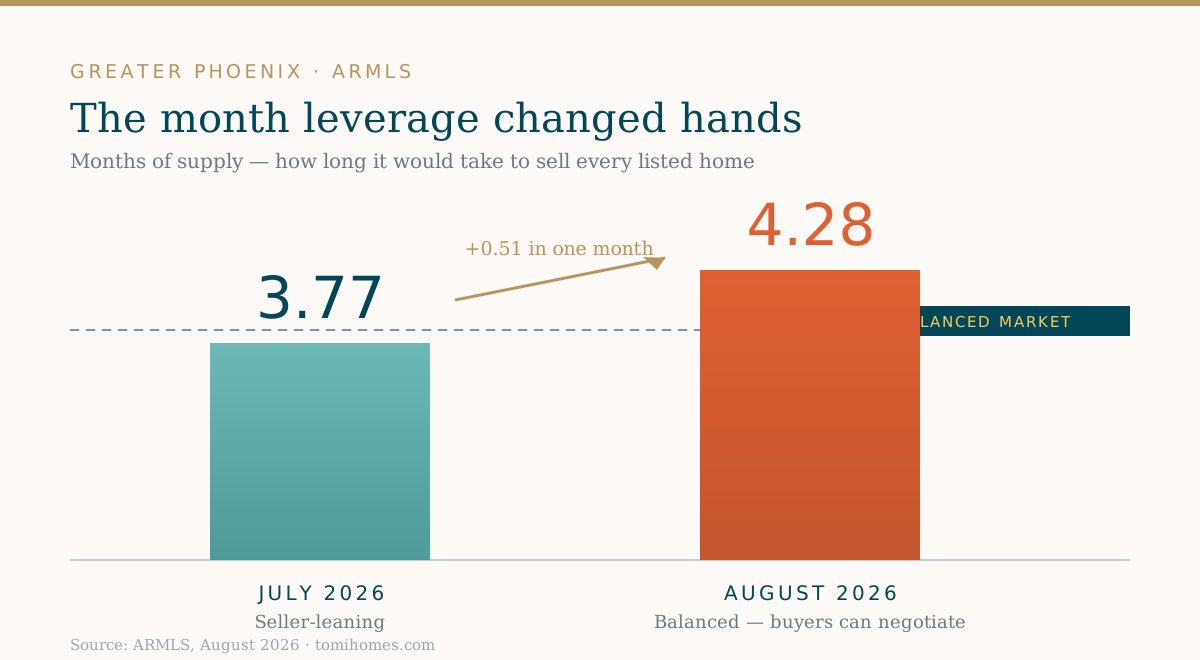
Greater Phoenix months of supply, July to August 2026. Source: ARMLS.
Prices flattened. They did not fall off a cliff.
The Greater Phoenix median sale price was about $445,000 in August 2026 — roughly 1% below July, and still up about 1% compared to the same month last year. Values held. What changed underneath them was how much room a buyer has to ask for things.
One thing worth understanding, because it confuses almost everyone: the City of Phoenix and Greater Phoenix are different numbers. Redfin's Phoenix city data put the median sale price near $460,000 across the three months ending in July 2026, up 1.7% year over year, with homes averaging about 55 days on market.
Metro-wide figures pull in Buckeye, Maricopa, Surprise and Queen Creek. City figures do not. When two articles quote different medians, that is usually why — not because one of them is wrong.
What that looks like in practice
| What you are reading | What it covers | Recent figure |
|---|---|---|
| Greater Phoenix median sale price | The full ARMLS metro footprint | ~$445,000 (Aug 2026) |
| City of Phoenix median sale price | Phoenix city limits only | ~$460,000 (3 mo. ending Jul 2026) |
| Months of supply, Greater Phoenix | Balance of power | 4.28 (Aug 2026), up from 3.77 |
Rates are the wild card, not prices
Mortgage rates are what moved this market in 2026, and they are still moving. Freddie Mac's Primary Mortgage Market Survey put the average 30-year fixed rate at 6.95% on September 17, 2026, up from 6.76% the week before. A year earlier the same survey read 6.26%.
That swing is worth more to your monthly payment than a $10,000 price negotiation. It is also the reason so many sellers are back to paying buyer closing costs and funding rate buydowns — something that essentially vanished during the frenzy years.
If you are running numbers, run them at today's rate, not the one you hope for. If rates improve later, refinancing is a conversation. Buying a home you cannot afford on the assumption rates will cooperate is not a strategy.
What a balanced market gets you that 2021 did not
- A real inspection period. Not a formality you waived to win.
- Appraisal protection. You are far less likely to be asked to cover a gap in cash.
- Repair requests that get answered. Sellers are negotiating again.
- Closing cost help. Concessions and rate buydowns are common, particularly in the sub-$500,000 range.
- Time. You can see a home twice, drive the neighborhood on a Saturday night, and sleep on it.
None of that shows up in a median price chart. All of it shows up in what you actually pay and what you actually own.
So who should buy right now?
Tomi's filter is simple, and it has not changed in over 30 years of doing this in the Valley.
Buy if
- You plan to stay put five years or longer
- Your income is stable and your payment fits comfortably, not barely
- You still have reserves after closing — a Phoenix roof and an AC unit do not care about your timing
- You found a home that genuinely fits how you live, not just what you can afford
Wait if
- There is a real chance you move again within two or three years
- You would be stretching to the last dollar of your approval
- Your job or industry is in flux right now
- You are only buying because someone told you the window is closing — it is not
Where in the Valley matters more than when
Greater Phoenix is not one market. It is a dozen, and they are not moving in the same direction at the same speed. Central Phoenix, Arcadia and the Encanto corridor behave nothing like Queen Creek or Surprise. North Phoenix and the West Valley have their own inventory picture. Scottsdale and Paradise Valley operate on an entirely separate clock.
The citywide median is a weather report for a state the size of Arizona. It tells you roughly what to wear. It does not tell you whether it is raining on your street.
That is the part a good agent earns their keep on — pulling the comps for your actual price band, in your actual ZIP code, and telling you plainly whether the leverage is yours or the seller's this month. The Tomi Homes team does that before anyone writes an offer.